
You know that feeling like, “When I listen to music, my body naturally starts grooving!” right? 🎵
I heard that this “nori” = groove is actually something you can learn theoretically!
Japanese engineer & drummer Miyuki Tani has teamed up with an associate professor from Berklee College of Music to launch the development of a new method called “The ONTSUBU Method” to teach groove through theory! 🥁✨
📖 Inside this article 📖
☝️ The difference in rhythm between Japan and the world lies in “Language”!
✌️ What is the structure of a groove?
🤟 A dream collaboration between Berklee College of Music and a Japanese drummer is realized
🎵 What’s the difference between Japanese rhythm and global rhythm?
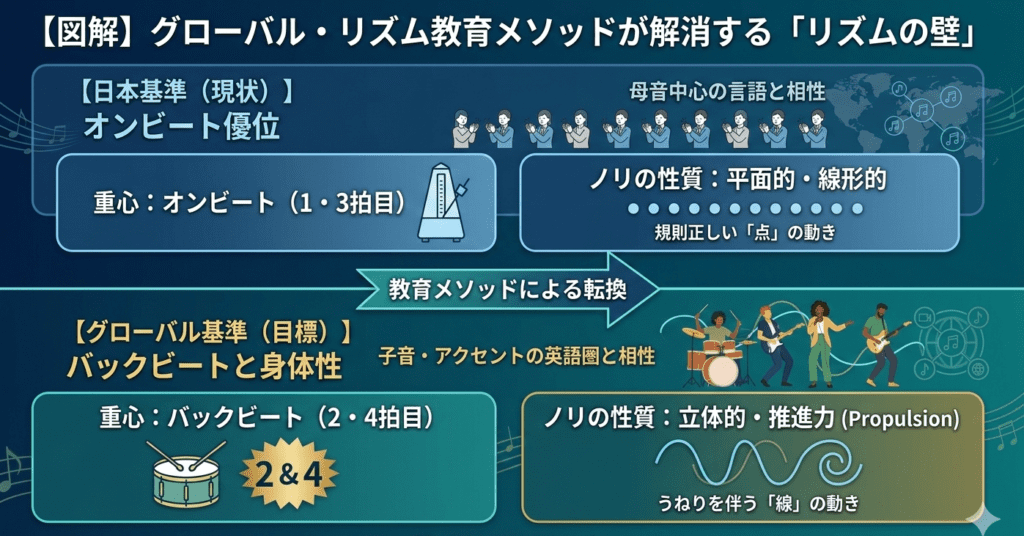
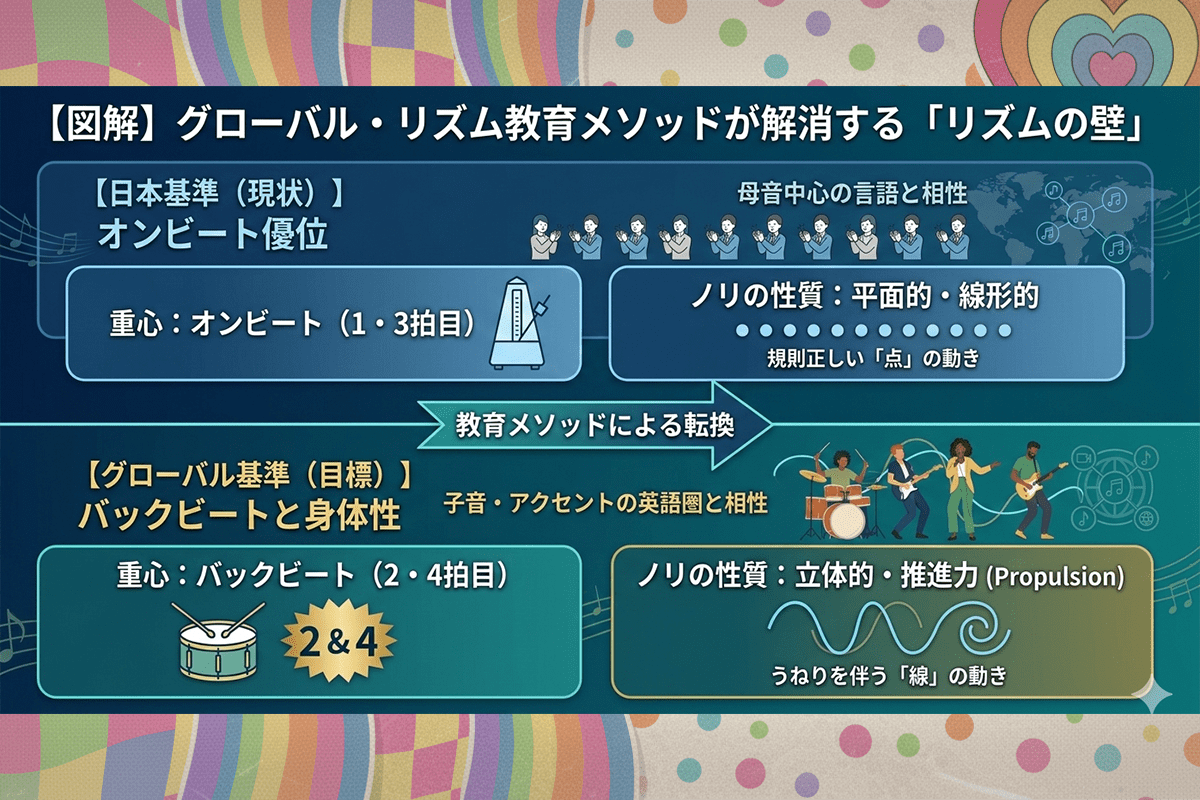
First of all, “Japanese-style rhythm” and “Global-style rhythm” are fundamentally different!
🇯🇵 Japanese Style: “On-beat” with strong 1st & 3rd beats
The characteristic of Japanese music is an “on-beat dominant” rhythm, where a heavy accent drops on the 1st and 3rd beats 👀
Because Japanese is a language with many vowels like “a, i, u, e, o,” the rhythm naturally ends up like this, apparently 🤔
The groove feels like a regular “movement of points,” giving a very precise and neat impression!
🌍 Global Style: “Backbeat” with strong 2nd & 4th beats
On the other hand, that wavy, three-dimensional groove you feel in Western music comes from the “backbeat,” where the center of gravity rests on the 2nd and 4th beats!
English is a language with strong consonants and accents, so it naturally creates a backbeat rhythm 👀
The groove is a “linear movement accompanied by undulation,” giving you the sensation of your body being physically pulled in! 🎵
In other words, the reason you feel that “Western music has a difficult rhythm…” is actually because of the rhythm barrier caused by differences in language! 💡
🔬 The 3 Secrets of Groove | The Mechanism Unraveled by the ONTSUBU Method
The core of The ONTSUBU Method is that it breaks down and structures groove into “3 layers” ✌ Yay!
It might sound complicated, but it’s easy to understand if you read along while looking at the diagram 👇
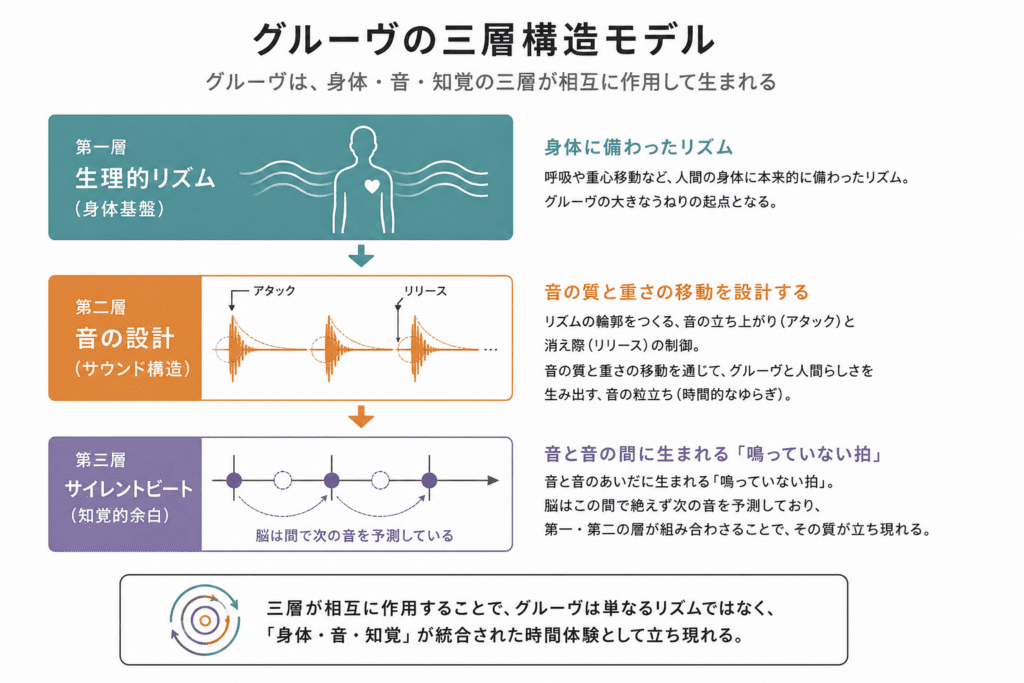
First Layer | Physiological Rhythm (Rhythm innate to the body) 🫀
The foundation of groove is the rhythm naturally inherent in the human body, such as breathing and shifting the center of gravity 💃
The very origin of that “body naturally moving when listening to music” feeling lies right here 🎵
Feeling the rhythm with your entire body is the first step to the groove!
Second Layer | Sound Design (What sound to play and how) 🎸
Controlling when the sound starts (attack = the rise) and when it fades out (release = the vanishing point) is crucial ☝️
The key point is to think of “when, what kind of sound, and at what timing to produce it” as a design process!
Instead of relying purely on instinct, you’ll be able to construct it using theory!
Third Layer | Silent Beat (The “space” between sounds) 🔵
This is the most interesting part! The Silent Beat refers to the “unplayed beats” between sounds.
Even during the moments when no sound is playing, your brain is constantly anticipating and preparing, going, “The next sound is coming!” 🧠✨
This “brain anticipation” was the true identity behind what gives a groove its depth!

(Lucky)
By combining these 3 layers, a groove becomes more than “just a rhythm”; an experience is born where the body, sound, and senses become one 👶 Isn’t that incredible?!
The Japanese aesthetic philosophy of “Ma” (space/pause) is also an important element of this new method!
|
|
![[Please note that product prices may have changed between the time this link was created and the present.]](https://hbb.afl.rakuten.co.jp/hgb/55433ba8.89da63df.55433ba9.6b6cfea1/?me_id=1285657&item_id=12764794&pc=https%3A%2F%2Fthumbnail.image.rakuten.co.jp%2F%400_mall%2Fbookfan%2Fcabinet%2F00376%2Fbk4003314611.jpg%3F_ex%3D240x240&s=240x240&t=picttext "[Please note that product prices may have changed between the time this link was created and the present.]")

🎓 Who developed it? A Japanese Drummer × Berklee College of Music Associate Professor
👩🎤 Developer: Miyuki Tani

The developer, Miyuki Tani, is a former Japanese engineer turned drummer 🥁
I heard she has been deeply researching groove while remaining active in the US music scene!
🌟 Berklee College of Music Associate Professor David Cowan Joins!
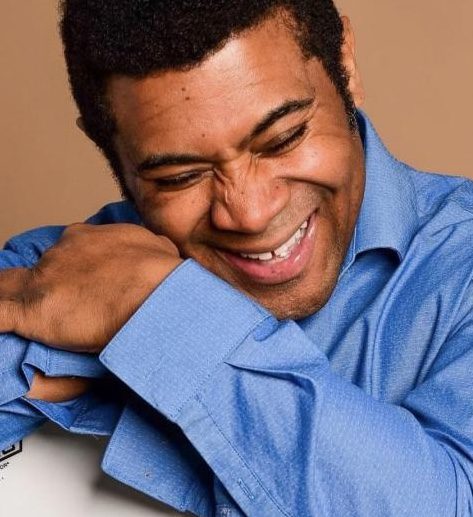
The advisor for this method is David Cowan, an Associate Professor at the renowned Berklee College of Music!
This is such fascinating research!! We’ll be cheering you on from Japan too! You got this!
🌈 Summary 🌈
✅ Groove is not just a “sense,” it can be learned through theory (structure) 🔥
✅ The difference between the Japanese style (on-beat) vs. Global style (backbeat) is the true identity of the “groove barrier” 🎵
✅ A collaboration between a Japanese drummer and a Berklee College of Music Associate Professor fully kicks off in 2026
🔗 Source: PR TIMES “ONTSUBU LLC Press Release”
🔗 Website: https://ontsubu.com/
















(Lucky)
I was always wondering on a daily basis, “What exactly is the difference between Western and Japanese music?” because it seemed like there was definitely something different beyond just the language, so this content was super interesting!
I’ll explain the contents of the release as simply as possible!